Ecco la traduzione in inglese del resoconto della Battaglia di Filottrano:
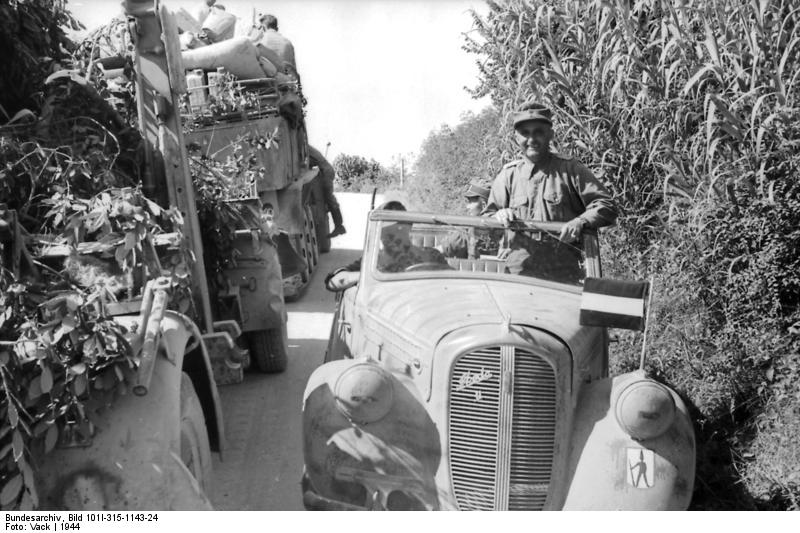
On April 16, 1944, the first Sunday after Easter, a German van was ambushed by a group of partisans in Via Cesare Battisti in Filottrano. Two of the four soldiers died, and the other two were wounded. To avenge the attack, the Germans surrounded the town and seized 16 men, who were then taken to the Carabinieri barracks and released only at midnight. The following day, the Germans carried out another roundup, sparing the hostages only thanks to the mediation of local authorities. However, the Felgendarmerie issued a manifesto declaring Filottrano a rebel town, thereby sanctioning its military occupation.
On June 30, 1944, another attack on a German truck took place. At this point, ten citizens were executed by firing squad. Meanwhile, between June 21 and 30, the Allies had fought along the Chienti river and forced the Germans onto the Albert Line, which followed the course of the Fiumicello stream to the Musone river and then to the sea. Defending this line were two divisions of German Grenadiers: the 278th, in the mountains; and the 71st, from Filottrano to the sea.
Facing them was the Polish II Corps, composed of two infantry divisions, one armored brigade, strong with at least two hundred tanks, two regiments of armored and motorized Uhlans, five artillery regiments of every caliber, and various minor units, totaling over 50,000 men. Also in the field alongside them was the CIL (Italian Liberation Corps) under General Utili: two incomplete infantry divisions, two artillery regiments, and minor service and liaison units; for a total of approximately 17,000 soldiers.
On the morning of July 1st, the Germans occupied the positions deemed essential for holding the stronghold: Villa Centofinestre, the hamlets of Montoro, San Biagio to the east, and Imbrecciata to the south. In the afternoon, the 15th Uhlan Regiment of Poznan, the vanguard of the Polish 5th Kresowa Division, crossed the river and attacked the village of S. Biagio, forcing the Germans to react; however, their counterattack on July 2nd foundered against the Allied troops. On the 3rd, the Poles managed to conquer Centofinestre, and on the 4th, Montoro. Meanwhile, the Italian Nembo paratroopers, who had pushed beyond the river to the south, were driven back by the Germans.
On the 6th, the battle concentrated in the town itself, fought primarily by German Grenadiers and Italian Paratroopers. On the 8th, the Italian paratroopers, protected by artillery, engaged in the decisive battle. They were repelled in the afternoon, but during the night, the Germans, having lost Castelfidardo and Osimo, also withdrew from Filottrano. In the morning, the Nembo scouts found the town abandoned. They freed the civilians from their shelters, and these civilians raised an Italian flag on the Aqueduct Tower, which is now preserved in the Council Hall of the Town Hall.
In the ten days of battle, the Italians suffered 56 dead, 231 wounded, plus 59 missing. The Germans lost about ninety men. The Battle of Filottrano is important because it opened the road to Ancona for the Allies, a decisive strategic objective due to the port which allowed for a shortening of the supply lines for the Allied units on the Adriatic. It is also remembered as the last engagement involving the Italian Liberation Corps (Corpo Italiano di Liberazione), commanded by General Umberto Utili, before it was reorganized later that summer into Combat Groups.