Filottrano: The City of Elegance
Details
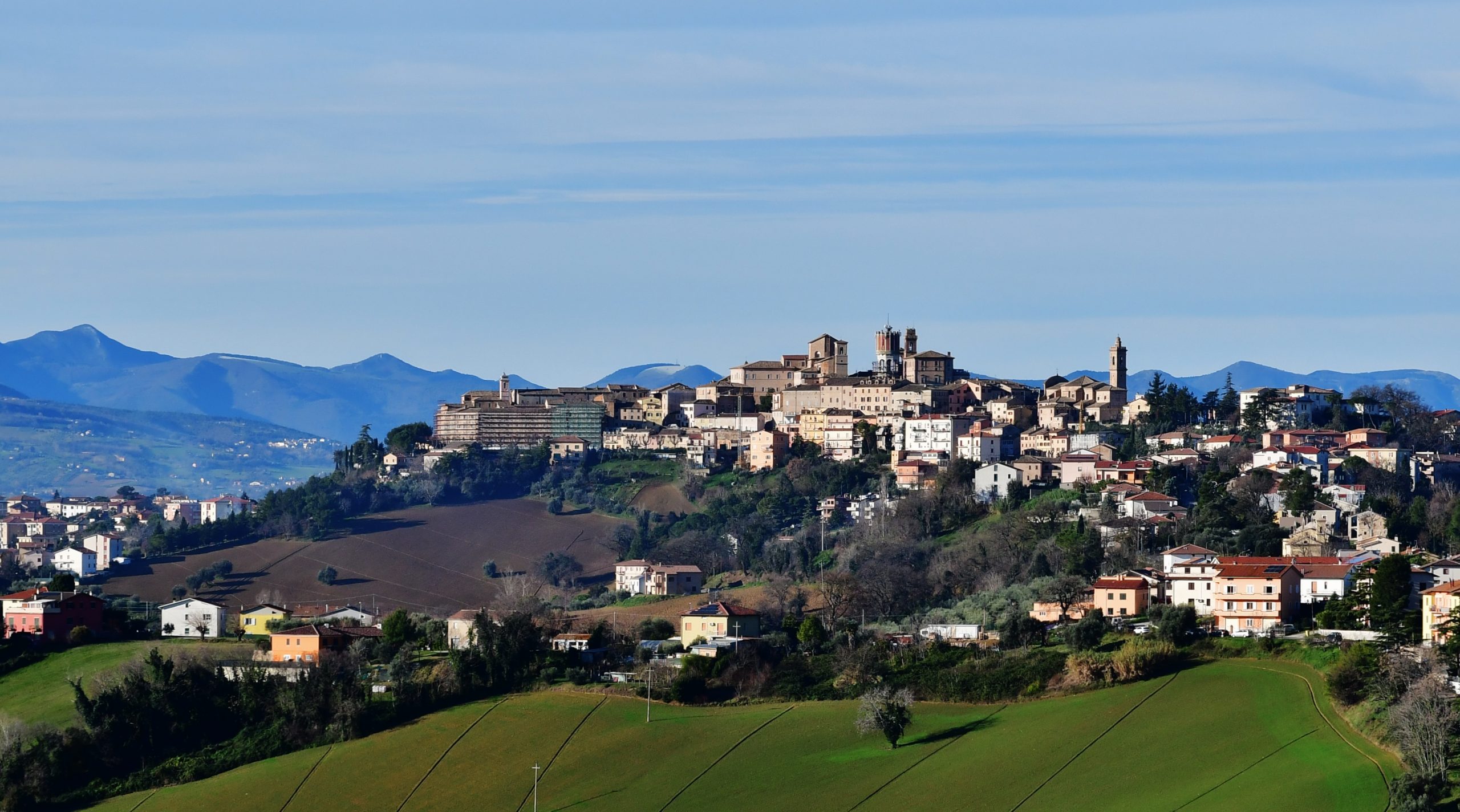
Filottrano is a hillside town situated in the Marche hinterland, rich in history and traditions. Its origins date back to the Early Middle Ages, although the territory was inhabited in much more ancient times. Archaeological evidence, found in the localities of Ripabianca, on the border with Osimo, and Codarda, near the Musone river close to Cingoli, attests to the presence of a hut-dwelling civilization dating back to the 3rd millennium BC.
The inhabited center still preserves traces of its medieval past, such as the remnants of the ancient walls and the Church of the Assumption, dating back to the 17th century, in addition to the 18th-century parish church. Local folklore is closely linked to peasant life and popular traditions, handed down over time through typical dances and songs. A symbol of the territory’s culture and craftsmanship is the Museum of the Marche Biroccio (agricultural cart), housed in Palazzo Spada Lavinj, now Beltrami-Luchetti, which also hosts the Beltrami Museum, featuring a collection of artifacts from North and Central America.
The city’s economy is primarily supported by the clothing sector, with a strong presence of industry and textile craftsmanship. To enhance both the decorative art of the birocci, which is unique in Italy, and the tailoring tradition of the town, the project “Filottrano Arte 2000. History and modernity from the Biroccio to Fashion” was established, forming the first core of what will become the Museum of the Territory.
Filottrano is also a place of memory: during the Second World War, it was the scene of violent fighting between German troops and the National Liberation Corps, supported by Polish soldiers. A permanent exhibition of war relics has been set up in memory of these events, alongside the Filottrano Battle Memorial.
A highly popular event is the Contesa dello Stivale (Contest of the Boot), a historical re-enactment that takes place every year on the first Sunday of August for over thirty years. The event includes itinerant performances with medieval musicians and jesters, a large costumed procession, and historical games that enliven the town’s streets.
Gallery
Medium
Multimedia Archive
Wikipedia (https://it.wikipedia.org/wiki/Filottrano)
Prehistory
The presence of man during the Eneolithic (Copper Age) is widely documented by numerous archaeological finds discovered in the Capannilico village located in the Ripabianca di Santa Paolina area, on the last small hill on the right bank of the Musone river before it flows into the plain.
From the Piceni to the Roman Empire
Subsequently, in the 6th century B.C., the Senoni Gauls settled even in Santa Paolina, where a very important necropolis, among the most significant in Italy, was found. The customs, traditions, and everything concerning the culture of the Gauls are described by Julius Caesar in his Commentarii de bello civili, in which the narration of military events sometimes gives way to true "ethnographic excursus" following the model of the greatest ancient historians, such as Herodotus and Thucydides. In Roman times, the colony of Veragra was built near the current Fratte, but the settlement was sacked and destroyed in 568 A.D. by the Ostrogoths.
Middle Ages
The first certain sources regarding the foundation of Filottrano date back to 1187 by Pope Gregory VIII, confirming the real existence of Filottrano already in those years. Etymologically, "Filottrano" is the synthesis of the formula "Mons Philiorum Optrani" (Mount of Optrano’s Sons), whom legend holds to be the city's Longobard founder. The people of Filottrano erected a statue in his honor in the post-war period and placed it in the main square, Piazza Mazzini. Initially, Montefilottrano was just a small oppidum, which was gradually enlarged over the centuries. During the Early and then the Late Middle Ages, the city's dwellings and fortifications were expanded; note in this regard the castle walls from approximately the 14th century. At that time, the economy was based on agriculture, as demonstrated by the dense network of caves beneath the town, which served to store provisions during times of famine, war, or particular drought. The caves are not open to visitors, although in some places the entry point can be seen. Also during the medieval period, Filottrano was involved in the conflict between the Guelfs and Ghibellines and, due to both border issues and political-religious interests, was linked to the nearby Cingoli (Cingulum) and Osimo (Auximum), as attested by the famous medieval festival of the "Stivale" (Boot), which brings to life the very suggestive and fascinating atmosphere of those times.
Of considerable importance is the large monastery of Storaco (12th–13th century, though perhaps the first settlements date back six centuries earlier), which no longer exists today, but sources confirm that it was an important pilgrimage site for the neighboring populations. Legend has it that the castle and the monastery were torn down to obtain the bricks needed for the construction of the town. Due to military events, the remaining church was partially damaged and has now been completely abandoned, neglecting its historical and artistic value. Montefilottrano was surrounded by many other "castles," which transitioned from being autonomous to being subjected to the largest castrum due to its importance and favorable higher position.
Modern Era
The town's location holds significant strategic importance, so much so that it was a stronghold that allowed the Allies to advance towards the liberation of Central and Northern Italy. In fact, between July 1st and 9th, 1944, the "Nembo" fought there in the Battle of Filottrano, which was undoubtedly one of the most outstanding operations of the Italian Liberation Corps and remains vivid in the minds of the inhabitants. With the first post-war period and the age of prosperity, the town grew from every point of view: demographically and economically.
The family of the poet from Forlì, Aldo Spallicci, originates from Filottrano.
Treasures of history and art: the places that tell the soul of Filottrano.
Religious Architecture
- Collegiate Church of Santa Maria Assunta [Building constructed in the 18th century upon a preceding 14th-century church.]
- Church of San Francesco [Dating back to the 16th century]
- Church of the Stigmata (Chiesa delle Stimmate) [Popular devotion for the 18th-century Crucifix considered miraculous.]
- Church of San Cristoforo [The building preserves 15th-century frescoes.]
- Church of San Michele Arcangelo [(18th century): currently undergoing restoration. The church has a 17th-century façade.]
- Church of Santa Maria degli Angeli [(18th century): permanent exhibition of 20th-century Lecce Nativity figurines.]
- Church of Santa Maria di Tornazzano [With 15th-century frescoes from the Marche school.]
- Church of Santa Maria di Storaco [(9th century - 16th century): derelict]
Civil Architecture
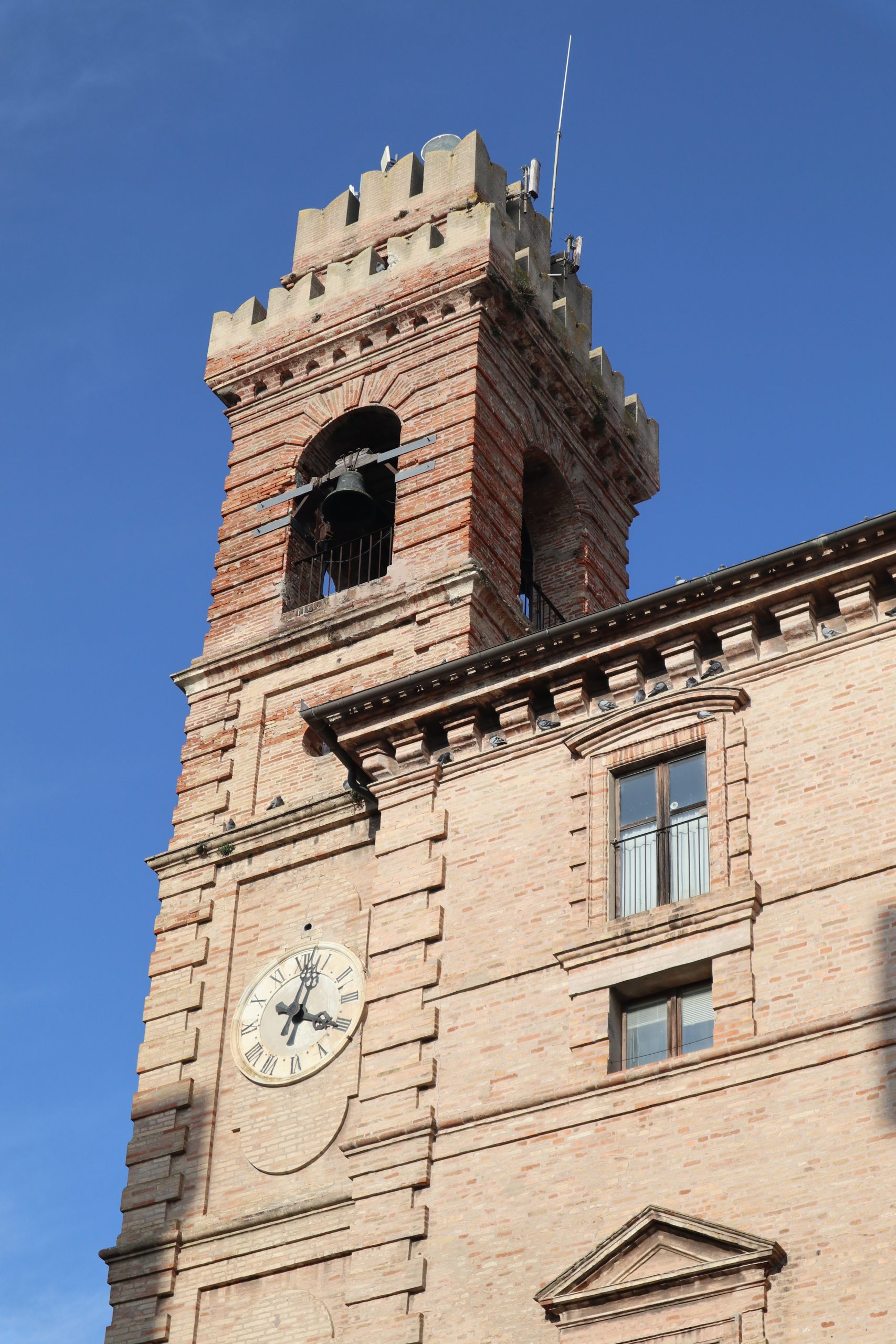
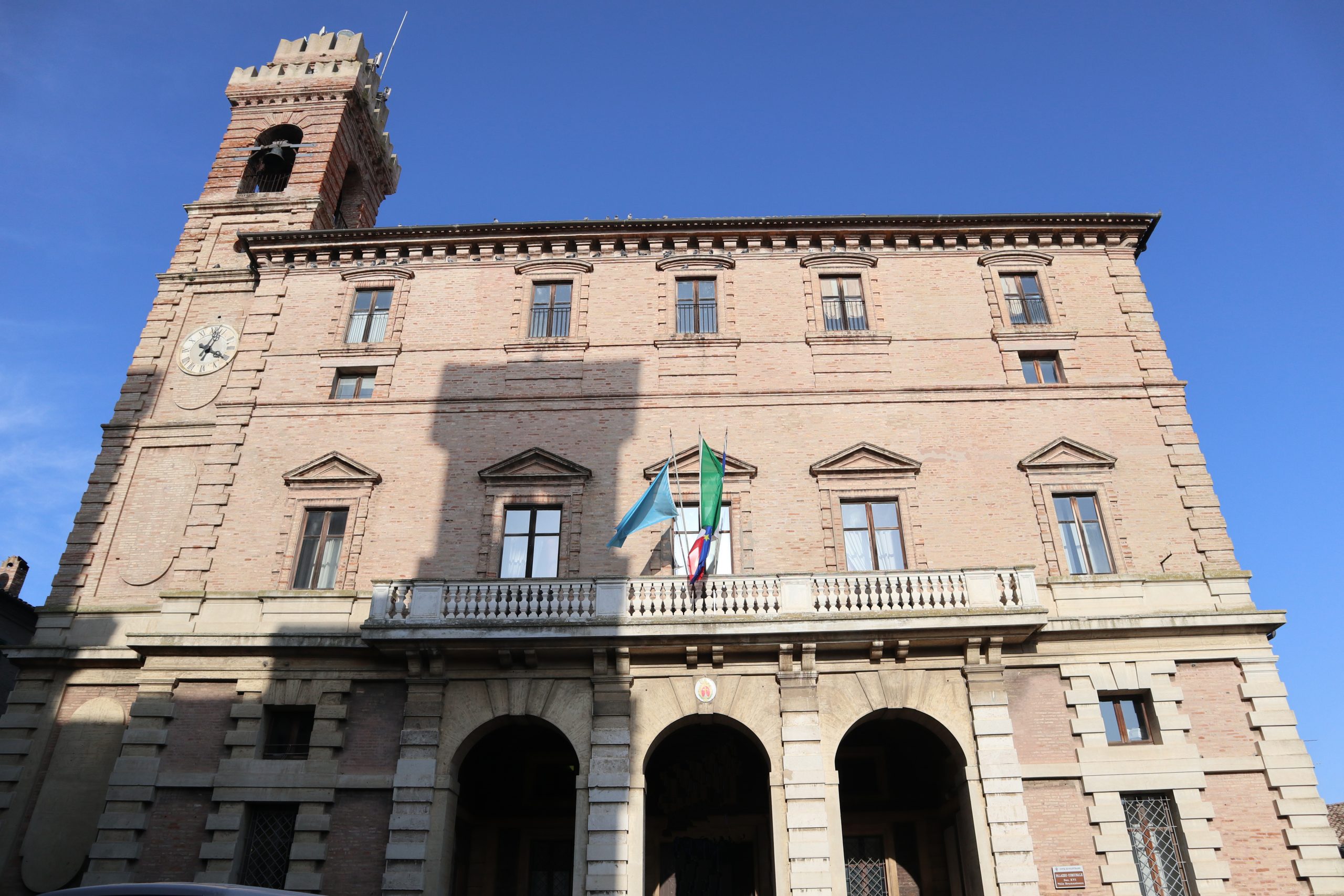
- Palazzo Comunale (Town Hall) [Renaissance-style building erected starting from the 16th century. The façade was completed in the 19th century.]
- Palazzo Accorretti [Features interesting late 18th-century pictorial cycles on the ground and noble floors.]
- Emidio Bianchi Library [17th-century complex with an elegant, carved wooden doorway.]
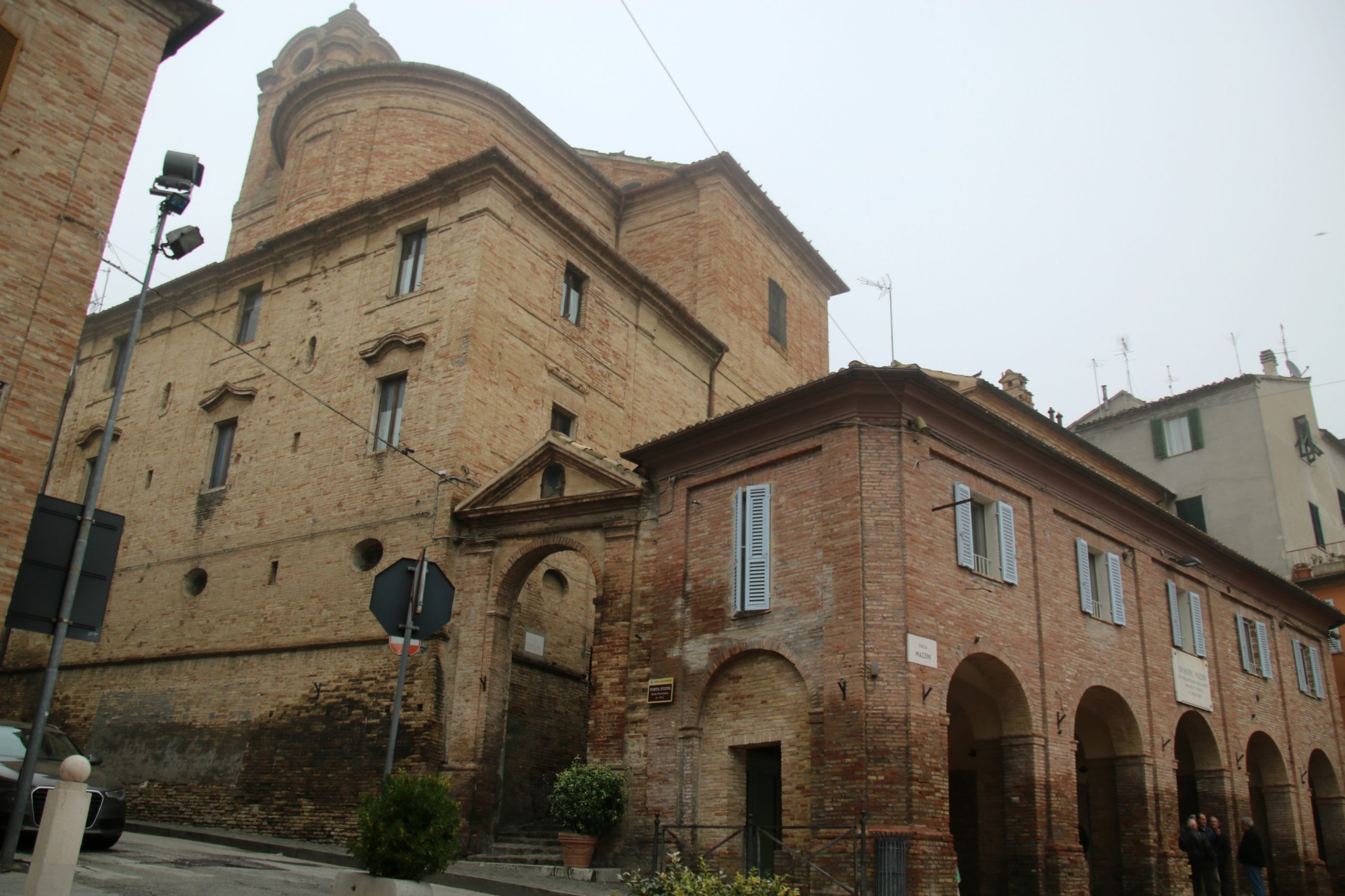
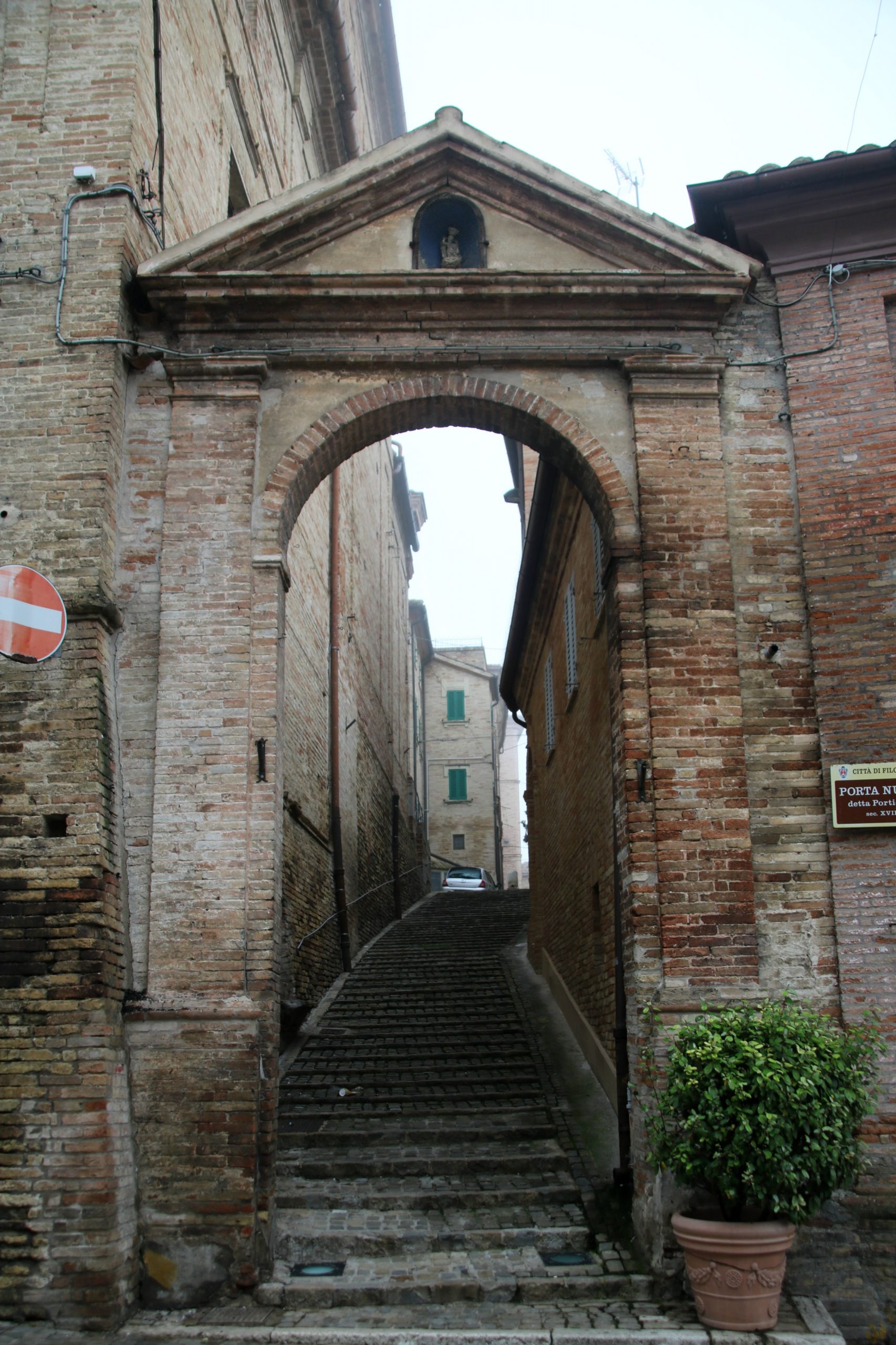
- Scalinata detta la Porticella (Stairway known as la Porticella)
- Villa Carradori or Centofinestre (Hundred Windows) [In Neoclassical style, it has one of the largest verve (green/ornamental) gardens in the Marche region.]
Contemporary Art
- Torquis Theatre (Teatro Torquis), work by the architect Cristiano Toraldo di Francia.
- "Lafabbrica" - youth center/space.
- Villa Spada: Location for the film "Il giovane favoloso" (The Fabulous Young Man) (2014) by Mario Martone.
Culture
- "Emidio Bianchi" Civic Library (Biblioteca civica): [Includes the municipal historical archive.]
- Museum of Rural Life (Museo della civiltà contadina): [It holds a private collection of typical objects from the Marche agricultural civilization.]
- Costantino Beltrami Museum (Museo Costantino Beltrami): [Collects objects and correspondence of the explorer.]
- Biroccio Museum (Museo del Biroccio) [Includes a collection of work tools, Marche agricultural carts, and carved yokes.]
- Sewing Machine Museum (Museo della macchina da cucire).
- Museum of the Battle (Museo della battaglia): Collects weapons, ammunition, uniforms, artifacts, and photographs.

Tailoring (SARTORIE)
Filottrano is "a fashionable town," because for over fifty years it has been an important textile hub for high-quality craftsmanship.
Big names and international brands collaborate with Filottrano tailoring workshops to produce many garments: high-class, casual, elegant, and made-to-measure.
The pioneer was Franco Carbonari in 1950, followed later by the Girombelli family. Currently, the leading names in tailoring are the Canali family, the Lardini brothers, the Tamantini, and Baleani.
The town offers as many as 14 corporate tailoring outlets where one can purchase excellent artisanal garments, and for the most curious or passionate, since 2017, it has been possible to visit the Museum of Sewing Machines, a vast collection of sewing machines from various eras.
Michele Scarponi
Michele Scarponi, nicknamed "The Eagle of Filottrano" (l’Aquila di Filottrano), was a great cyclist from the Marche region who never left his bike from the age of 8 until his death in 2017 due to a road accident.
Throughout his career, he achieved many national and international victories and recognitions. He participated in various races around the world: the Giro d'Italia, Vuelta a España, Costa degli Etruschi, Tour de France, and many other competitions where he played a leading role.
In memory of Michele Scarponi, the "Michele Scarponi Foundation" was established for everyone's safety on the road, with the aim of educating people on correct road behavior and a culture of respecting rules and others.