Mazzini Square – Garibaldi Square
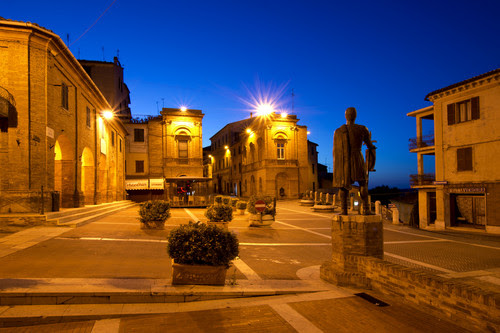
Begin your exploration in the beating heart of Filottrano, Piazza Mazzini, where history unfolds as an open dialogue between eras: the Statue of Ottrano, the legendary Lombard founder, welcomes you, introducing the town’s distant past, while in front of you stands the imposing arch of Porta Nuova/Porticella, the majestic entrance to the 14th-century city walls. This elegant square, with its panoramic loggia, offers the first breathtaking views of the Marche hills, making it a perfect spot for a “piazza pause” and a coffee before continuing your journey.
You walk along the elegant and short Corso del Popolo, a stroll of just a few minutes past ancient brick palaces and local shops, where thoughts turn to Filottrano’s tailoring tradition—a vibrant center of Italian craftsmanship, recalling skillful cuts and fabrics.
The Corso opens onto Piazza Garibaldi, where the atmosphere suddenly becomes more intimate and conventual: on the left, the austere façade of the Church of the Holy Stigmata conceals a surprising interior, rich with Baroque decorations, frescoes, and an imposing wooden altar; on the right, the severe ensemble of the Church and Monastery of the Clarisse closes the perspective, with its reddish façade and the statue of the Virgin, a testament to a still-active and contemplative monastic life.
From Garibaldi, the path becomes more intimate along the alleys leading to the Church of San Francesco (1531), followed immediately by the civil power at the heart of the historic center: the Palazzo del Comune, a refined Renaissance building from 1530, flanked by the tall merloned Civic Tower with its clock.
Continuing downhill towards Porta Marina, the Church of Santa Maria Assunta (1679) is revealed, a Baroque treasure housing paintings by artists such as Parrocel and Van Schayck, and most notably, the tomb of Giacomo Costantino Beltrami, the Filottrano-born explorer and patriot.
The itinerary concludes with a climb up the white steps to the Public Gardens, a panoramic green area ideal for a pause and reflection next to the Monument to the Fallen, before reaching the millennial Church of San Cristoforo, erected in 1218—a masterpiece blending Romanesque and Gothic styles, enchanting visitors with its ancient frescoes, including The Last Supper and The Nativity.
Finally, for those wishing to honor more recent history, a visit to the Filottrano Battle Memorial and the Permanent World War II Exhibition is highly recommended—a moving tribute to the events of July 1944.