A Project for the Museum of the Mississippi Explorer
The museum houses artifacts from the populations of North and Central America collected during the voyages that Giacomo Costantino Beltrami undertook on the American continent, which led him to discover the sources of the Mississippi in 1823. On August 31st of that year, he reached the border with Canada at Red Lake. Here he discovered another lake, which he named Lake Giulia (its current name is Itasca), in honor of the noblewoman Giulia De Medici Spada, whom he met in 1809 and who died prematurely; he considered this lake to be the northernmost source of the Mississippi. This is how he described that landscape: “The lake has a circumference of about three miles: it is heart-shaped and speaks to the soul. Mine was moved by it.” He collected numerous objects as testimony to his adventures, now preserved in the museum dedicated to him in Filottrano, where he died in 1855, and in the Museum of Natural History in Bergamo, his birthplace, which has dedicated a specific area to him.
In Filottrano, the Beltrami Museum, founded in 1979 by Glauco Luchetti Gentiloni, holds artifacts, manuscripts, and various objects—a heritage that will once again be opened to the community and enhanced with a project presented today at a press conference by the Municipality of Filottrano and the Polytechnic University of Marche, with Rector Sauro Longhi, Mayor of Filottrano Lauretta Giulioni, and Prof. Paolo Clini in attendance.
THE HISTORY OF BELTRAMI
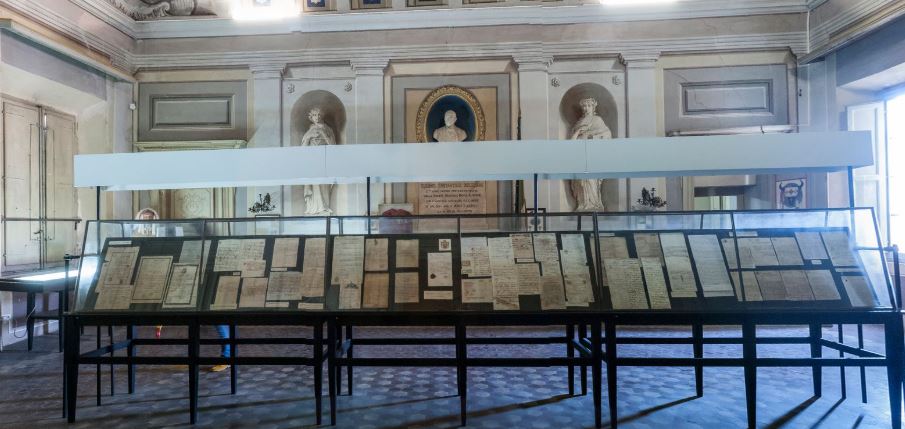
The fascinating story of the explorer Beltrami tells us not only of his spirit of adventure, which led him to know American tribes and peoples, collecting calumets, scabbards, belts, and Aztec and Mexican terracotta, but also of his passion for knowledge, as demonstrated by the manuscript of Beltrami’s volume “Le Mexique,” which is still unpublished in Italy, containing an account of his journey in that country and housed in one of the display cases.
Giacomo Costantino Beltrami, born in Bergamo in 1779 and died in Filottrano in 1855, was an Italian explorer and patriot. It was his talents as an explorer, combined with a good dose of courage and spirit of adventure, that allowed him to discover the sources of the Mississippi River, a place no pioneer had ever managed to reach, by tracing the almost 4,000 km of the longest river in the Americas backward. Several years later, these lands he discovered paid him due tribute by naming both the eponymous county of the current state of Minnesota and the mountains from which the aforementioned river originates after him.
It was in Filottrano that Beltrami decided to retire, in the Palace now called Beltrami-Luchetti (Vicolo Beltrami 2), where all his precious memorabilia are located on the first floor. The floor of the beautiful Palace is currently closed for restoration work. The Municipality, together with the owners of the building where the Beltrami Museum is located, has decided to renew the museum, opening it to the city according to new standards of museum utilization.
THE PROJECT
The project by the Polytechnic University of Marche, which has already begun digital surveys inside the Palace, will address the architectural aspect, the digitalization of the cultural heritage, and finally, the restoration of the ethnobotanical archive (herbarium). It will follow the theme of water to retrace the discovery that made Beltrami famous: the sources of the Mississippi River. This heritage holds value for communities and societies, making its preservation and transmission to future generations important. The unique figure of Beltrami, combined with the particularity of the building, requires an innovative intervention from an architectural, display, museographic, and narrative perspective.
The Polytechnic University referents following the project will be: Prof. Gianluigi Mondaini for the architectural part, Prof. Paolo Clini for digitalization and digital narration, and Prof. Fabio Taffetani for the restoration of the herbarium. The goal is field experimentation of the best exhibition and narrative options using innovative tools that simultaneously enhance one of the most beautiful buildings in the city of Filottrano and its unique content—one of the most original collections belonging to a figure whose brilliant adventure is still entirely waiting to be discovered and told. The university, with its expertise, will pursue the objective of the scientific and cultural enhancement of the objects and the herbarium, with attention to naturalistic and ethnobotanical aspects.