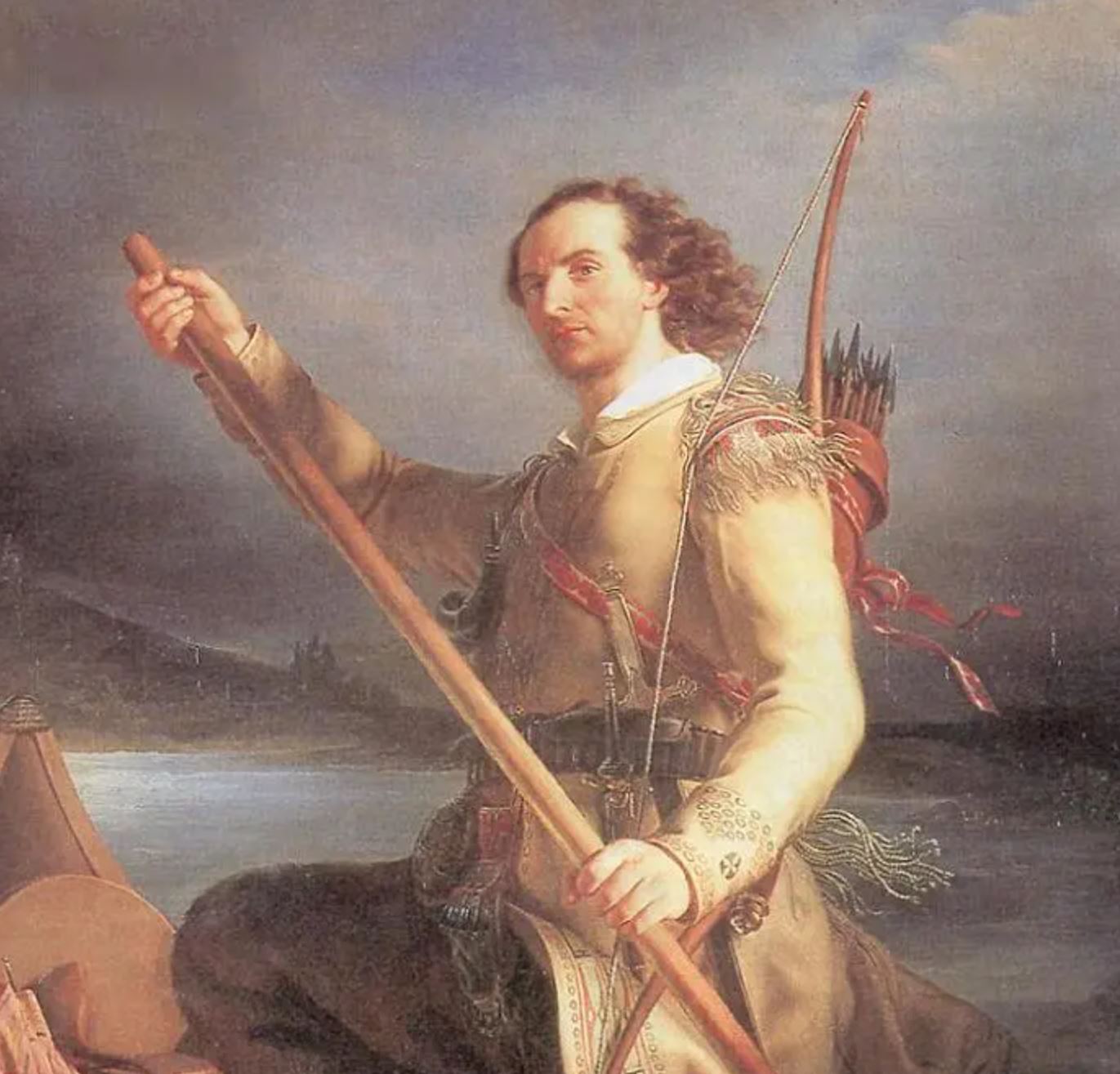
He was one of the seventeen children of a customs official of the Venetian Republic and was born in Bergamo in 1779. His father intended for him to pursue legal studies for a secure and stable career as a functionary, like himself, but the young Giacomo quickly displayed his intolerance for that old and tedious world. With a rebellious spirit like many young libertarian spirits of the era, he wanted to change the world and went to fight for the Cisalpine Republic, founded by Napoleon.
He took part in the first Italian libertarian movements, was imprisoned multiple times, and in 1818 was accused of conspiracy against the Papal States, avoiding the gallows by managing to be acquitted.
A man of both action and thought, it is said that, like many restless spirits of the time, he was a Carbonaro (member of a secret revolutionary society), initiated into Freemasonry, and that he worked as a judge in the Napoleonic Tribunals, first in Udine and then in Macerata. He was pursued by Papal gendarmes for being a free thinker, and perhaps the Enlightenment idea of the myth of the noble savage pushed him toward a friendly attitude toward the Native Americans, or “perhaps free and disillusioned by the burden of apparently tolerant and falsely egalitarian ideologies, he surrendered to the natural passion for adventure and lived like an Indian warrior.”
In 1821, he moved to France, then to London; here too, the situation was confining for his libertarian spirit.
In November 1822, he embarked from Liverpool for Philadelphia in the United States of America, carrying a curious red umbrella, which would characterize him throughout his adventure. In St. Louis, fascinated by the New World and the great prairies, he joined the Clark expedition, whose task was to inspect the forts along the upper course of the Mississippi.
Traveling on horseback or by canoe, he explored the lands of the Sioux and the Chippewa, where he became known and respected for his courage. He showed great interest and respect for the cultural and social traditions of the Native Americans, even compiling an English-Sioux dictionary and writing interesting works on ethnography and geography.
Among these works is “La decouverte des sources du Mississipi e de la Rivière sanglante” (The Discovery of the Sources of the Mississippi and the Bloody River), based on his travel diaries.
He then participated in Major Long’s expedition towards the Canadian border, up to the Red River area, continuing alone toward Red Lake. In an adventurous “ascent,” he unveiled the secret of the origins of the world’s third-longest river, reaching a point where American pioneers had not dared to go in his desire to discover the origins of the Mississippi, the “Father of Rivers” in the language of the Algonquian Indians. He discovered a small lake that he baptized Lake Giulia in honor of his beloved Giulia De Medici Spada.
The figure of Beltrami has not yet been sufficiently studied in Italy; his merits as a geographer and anthropologist have not yet been carefully evaluated.
His impressive correspondence includes letters from Jefferson, La Fayette, Chateaubriand, and Constant, some of which are still unpublished.
In Minnesota, the state’s largest county (Beltrami County) and the mountains containing the sources of the Mississippi bear his name.
The Beltrami Collection
The Bergamo Library holds the “Giacomo Costantino Beltrami Collection“: a mixed fund distributed in seven folders containing documents, travel notes and annotations, press clippings, letters, and various miscellanea; the manuscripts are of notable interest for their rich geographical and ethnographic observations on the visited locations and peoples. The extraordinary objects collected by Beltrami are now divided between the collection at the Ettore Caffi Museum of Natural Sciences in Bergamo and the Beltrami Museum in Filottrano (Ancona).
Costantino Beltrami Collection
Arriving at the Museum in 1917, after being ceded to the Municipality of Bergamo in 1855 by Giobatta Beltrami, the explorer’s nephew, the Giacomo Costantino Beltrami collection is of extremely high historical value, as the objects within it were donated to him by the Native Americans he encountered during his journey in the upper Mississippi River region in the first half of the 19th century.
It includes weapons, ritual objects, and everyday items of the Chippewa and Sioux Indians, as well as interesting artifacts that Beltrami brought with him from Mexico and Haiti, where he traveled after discovering the sources of the Mississippi.
The presence of the diaries that the explorer compiled during his travels, now preserved at the Angelo Mai Civic Library, has allowed scholars from both Italy and the United States to better understand the meanings and uses of the artifacts and enhance their historical significance through in-depth studies.
Part of the artifacts that Beltrami collected during his travels in America are kept at the Beltrami Museum in Filottrano, where the explorer spent part of his life. This is a private collection owned by the Lucchetti family. Invited to Bergamo in 1973 for the celebrations of the 150th anniversary of the discovery of the sources of the Mississippi, Glauco Luchetti donated three highly valuable artifacts to the Museum.
Autore: Francesco Dal Pino
The individual completed studies in Chinese Language and Culture within the Faculty of Political Science at the Università Statale di Milano, including a study trip focused on Qi Gong and Traditional Chinese Medicine (TCM) in China in 1992. They have since worked as a researcher in the field of TCM. During their time in China, they also had the opportunity to participate in informal martial arts fighting competitions. Furthermore, this background is complemented by research into esoteric and hermetic cultures, along with dedicated practice and cultivation of meditation. They are also a highly knowledgeable expert in Holistic and Holotropic Disciplines, having achieved Master Reiki certification in 1995 (under Beppe Perteghella), completed Kinesiology (Touch for Health) studies at ISKEN (under Maurizio Piva) in 1996, and conducted SHIATSU studies at Accademia Shiatsu Do Milano in 1990, in addition to qualifications in Holistic Massage and Foot Reflexology from CENTRO RIFLESSOLOGIA FITZGERALD in 1996.